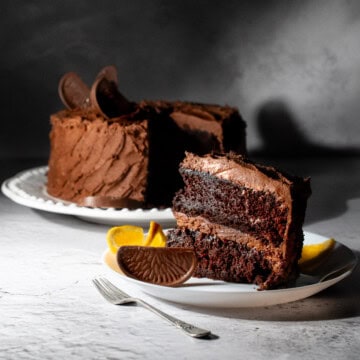
Chocolate Orange Cake
This super-easy chocolate orange cake is rich, moist and gooey, bursting with subtle hints of orange!Infused with zesty orange peel, fresh orange juice, tangy marmalade and orange-flavoured chocolate, this cake is a dream come true for chocolate orange lovers.
Equipment
- 2 x 8" (20cm) round baking tins
Ingredients
For the cake
- 400 grams light brown sugar
- 220 grams all purpose flour
- 85 grams cocoa powder
- 2 teaspoons baking powder
- 1 teaspoon bicarbonate of soda
- 1 teaspoon salt
- 2 eggs at room temperature
- 240 grams sour cream at room temperature
- 120 millilitres strong black coffee use one heaped teaspoon of instant espresso or coffee granules dissolved in 120ml water
- 120 millilitres orange juice
- 120 millilitres vegetable oil
- 1.5 teaspoons vanilla extract
- zest of one orange
For the chocolate orange buttercream
- 250 grams unsalted butter softened
- 460 grams icing sugar sifted
- 100 grams orange flavoured chocolate, melted like Cadbury's orange chocolate or Terry's chocolate orange
- 50 grams cocoa powder sifted
- 1-2 tablespoons orange juice to loosen up the buttercream
- 120 grams orange marmalade smooth or fine-cut
Instructions
To make the cake
- Preheat the oven to 180C/356F/gas mark 4.
- To prep the cake tins, cut two circles of parchment paper to fit the bottoms of your 20cm (8") pans. Place the parchment circles in the tins, then lightly butter or spray the sides with a non-stick spray.
- In a large mixing bowl, add the light brown sugar, all-purpose flour, cocoa powder, baking powder, bicarbonate of soda and salt.400 grams light brown sugar, 220 grams all purpose flour, 85 grams cocoa powder, 2 teaspoons baking powder, 1 teaspoon bicarbonate of soda, 1 teaspoon salt
- Use a balloon whisk to thoroughly combine the dry ingredients, breaking up any lumps, especially in the brown sugar, which tends to be a bit clumpy.
- In a small bowl, whisk the eggs with a fork to break them up.2 eggs
- Add the beaten eggs, sour cream, prepared coffee, orange juice, oil, vanilla extract and orange zest to the dry ingredients.240 grams sour cream, 120 millilitres strong black coffee, 120 millilitres orange juice, 120 millilitres vegetable oil, 1.5 teaspoons vanilla extract, zest of one orange
- Using an electric hand mixer on low speed, beat the ingredients until just combined. Be careful not to overmix.
- Divide the cake batter evenly between the two cake tins. If you want to weigh it, you should have around 700g of batter per tin.Give each tin a gentle tap on the counter to release any air bubbles.
- Bake the cakes in the preheated oven for 35 minutes or until a cake tester inserted into the centre comes out mostly clean. Since this is a moist cake, a few crumbs on the tester are normal. The cakes are done when they feel firm to the touch on top.
- Let the cakes cool in their tins for at least 10 minutes. Use a palette knife or offset spatula to gently loosen the cakes' edges from the tins.
- Carefully tip the cakes upside down onto a wire rack, remove the parchment paper and let them cool completely before decorating.
To make the chocolate orange buttercream
- Add the softened butter and icing sugar to the bowl of a stand mixer.250 grams unsalted butter, 460 grams icing sugar
- Beat the mixture on medium-high speed until it’s light and fluffy, about 5 minutes.
- Next, add the melted chocolate and cocoa powder. Beat until everything is well combined, creating a smooth and creamy chocolate orange buttercream.50 grams cocoa powder, 100 grams orange flavoured chocolate, melted
- Add the orange juice a little at a time, starting with one tablespoon, until the buttercream is spreadable. Mix well after each addition. If you want it thinner, add another tablespoon. Adjust as needed to get the texture you like.1-2 tablespoons orange juice
Assemble the cake
- Spread a layer of marmalade on the first cake, then add a layer of buttercream. Place the second cake on top to sandwich them together.120 grams orange marmalade
- Finally, spread the remaining buttercream over the top and sides of the cake, smoothing it out for an even finish.
- Add any extra decorations to the top of the cake if you like, such as chocolate shavings or orange slices.
Notes
Weigh your ingredients
For precise measurements and perfect results, a digital kitchen scale is your best friend. If you haven't gotten one yet, put it on your Christmas list, pronto! You won't regret it.Scrape the bowl
When whisking the batter, be sure to scrape the bottom of the bowl to catch any hidden flour. It can easily get trapped under the liquid ingredients, so give it a good scrape to incorporate everything.How to get cakes of equal height
To ensure your cakes come out the same height, weigh each tin after pouring in the batter. Aim for about 700g in each tin. If needed, adjust the amounts to get them as even as possible. This way, you'll have consistent, evenly baked layers.Sift your icing sugar and cocoa powder
Don’t skip sifting the icing sugar and cocoa powder! It’s the secret to a smooth, lump-free buttercream. It makes decorating a whole lot easier and your cake look and taste amazing.How to make cakes easier to frost
Popping your cakes in the freezer for an hour or two before decorating makes them firmer and so much easier to frost.How to avoid a cloud of icing
When you start beating the butter and icing sugar, keep the mixer at the slowest speed to avoid a cloud of sugar dust. You can also drape a tea towel over the bowl to keep things tidy. Or, try pressing the butter into the sugar with a spatula first - this helps prevent the sugar from flying everywhere when you turn on the mixer.How to deal with a dome on your cake
To tackle a dome on your cake, try flipping it upside down while it's still warm. This way, the bottom of the cake becomes the top, giving you a flat surface. If you prefer, you can also trim off the dome with a serrated knife to achieve a perfectly even top.Nutrition
Calories: 697kcal | Carbohydrates: 110g | Protein: 11g | Fat: 29g | Saturated Fat: 8g | Polyunsaturated Fat: 8g | Monounsaturated Fat: 10g | Trans Fat: 0.1g | Cholesterol: 39mg | Sodium: 401mg | Potassium: 445mg | Fiber: 6g | Sugar: 85g | Vitamin A: 194IU | Vitamin C: 7mg | Calcium: 127mg | Iron: 4mg
